















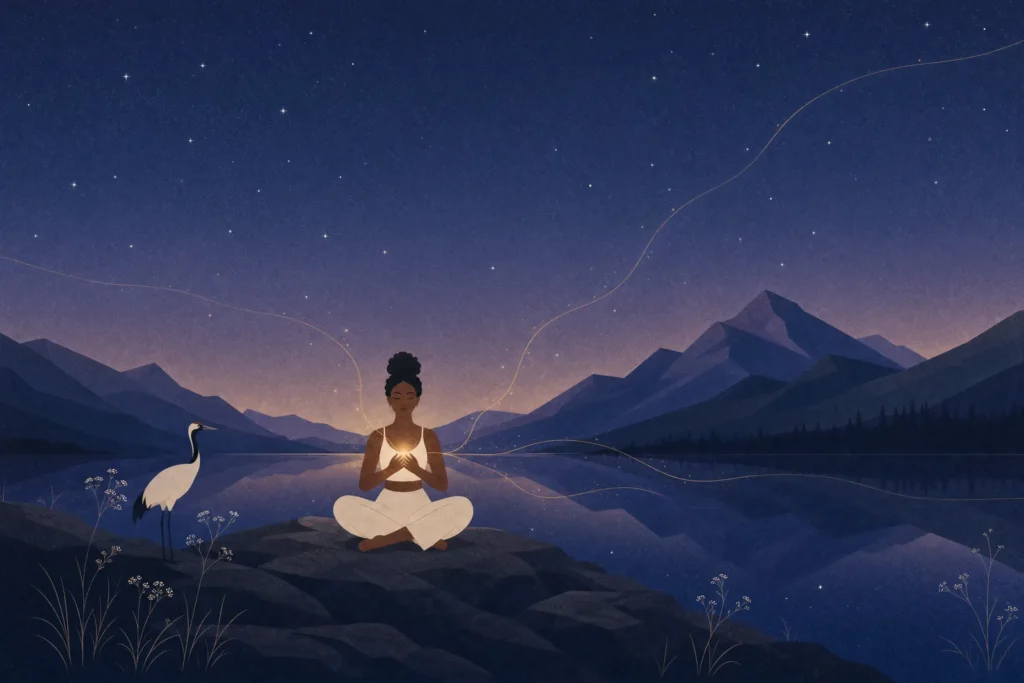
Guided imagery meditation is being led, in words, to picture something: a field at sunset, a golden light, a large wooden door. You don’t need to see it clearly. The picture gives your mind something to hold instead of your thoughts, and the feeling that comes with it is where the work happens.
It’s the technique we use most across our sessions, though we rarely call it that. In the sessions you’ll hear “use your inner vision”, “imagine”, or simply “picture this”.
This article explains what we ask you to picture, why a picture reaches the mind when an instruction doesn’t, and a short practice you can try now.
What guided imagery meditation actually is
Four things make it what it is.
- It’s guided. Someone leads you, so you don’t have to hold the thread yourself.
- It’s imagined. You’re not remembering or analysing. You’re building a scene.
- It’s sensory. The warmth of sun on your skin, a breeze, a colour, a weight in the chest.
- It ends in a question. How did it feel, and what came up? The picture is the door, not the destination.
A typical instruction from one of our sessions sounds like this: “Use your inner-vision and imagine a large wooden door. The door is shiny. It has golden edging and creeks when opened.” The detail isn’t decoration. Detail is what gives the mind something to settle into.
Why a picture works when an instruction doesn’t
Telling a busy mind to relax rarely works. Giving it something to picture usually does. There are three reasons we lean on this so heavily.
Thoughts are neutral until you give them meaning. As we put it in our sessions, “everything is neutral until we connect emotion to it”, and “all thoughts are neutral until we give meaning to them.” Imagery works with that. It changes the meaning attached to something, rather than arguing with the thought itself.
Second, energy follows attention. “Your mind is a sponge, absorbing the energy it’s exposed to. To shift your mind, you must shift your energy. To shift your energy is to change your thoughts.” A picture is the quickest way to change what your mind is exposed to.
In deep meditative states, the mind works with metaphors in order to show you meaning.
That’s the third reason, and the most important one. Pictures are the language the deeper mind already speaks. When you go looking for meaning in a quiet state, it rarely arrives as a sentence. It arrives as an image, a colour, a sense of something.
We’re not going to point at brain scans here. What we can tell you is what these images are for, and what tends to happen when people use them.
Four jobs imagery does in our sessions
Look across the sessions and the same handful of purposes come up again and again: calming a busy mind, meeting fear safely, working with the body, and opening a sense of connection.
1. Imagery for calming a busy mind
The first image most people meet in our work is the simplest one. Thoughts as clouds:
Imagine each thought likened to a fading cloud in the vast open sky, continuously forming and floating gently away.
You don’t push the thought away or scold yourself for having it. You watch it form and drift. Then a warmth follows, “a warm, nurturing energy surrounding your body”, which we name as love rather than leaving it abstract.

Other calming images we use: lying on a beach in the late afternoon sun, with the warmth rising from your feet to the crown of your head. Floating on a cloud, “its soft, white fluffy texture embracing you”. Returning to a place that feels like home, where we ask: “What your home represents to you is your most comfortable place. Who is with you? What does it look like?”
2. Imagery for meeting fear and old memories
This is where imagery does something no instruction can. It lets you approach something painful from a safe distance.
Our fear sessions begin by building a room: “Imagine that you are in a beautiful room. The room is filled with the things you love. You feel at home. You feel safe in this room, your room.” Only then do the memories come, and they come as pictures on the wall, not as reliving.
The safety principle: “The memories stand at a range, never coming close enough for you to experience the pain and relive it firsthand.” You observe. You don’t re-enter.

The same principle runs through the wooden door, which “represents your higher mind and its way of unlocking consciousness”. You look through it and see what has been holding you back, and then you give it peace rather than wrestling with it.
And then there’s the image we return to most when working with fear: golden sunlight. You choose one fear, a small and manageable one, and “imagine a sort of golden sunlight; bring this golden sunlight towards your fear. The light is streaming in, directly from your consciousness.” Then, slowly, four times over: “See the fear change.”
Nothing is forced. You’re not told the fear will vanish. You’re asked to notice what it has become, and to accept that.
3. Imagery for the body
Feelings live in the body, so a good deal of our imagery is physical. In one session you simply breathe towards each part in turn, with a breath between each: your skin, your belly, your legs, your arms, your heart. Then you notice where it felt heavy, and let your attention stay there.
In another, you hold your palms apart and “imagine a ball of profound bright electric blue energy filling this space between your palms”, which is often the first time someone feels energy rather than thinking about it.
And when something needs releasing, we use dissolving: “let your body become water; let it now become air; now, let it become nothingness.”

4. Imagery for connection and insight
The last group opens outward. You picture yourself as “a spark of light surrounded by nothingness”, and then watch that light expand until it fills everything, which is how we explain the difference between the ego self and the higher self.
You see “the light pouring out through the middle of your heart outwardly into infinity”, and let it touch every other being.
Or you meet your higher self directly, and we deliberately leave the form open: “This higher version of yourself may come in many forms.” Some people see a figure. Some see light. Some just feel a presence. All of it counts.

There’s one more we’re fond of, for insight rather than calm: imagine you’re a famous artist “who, with their imagination, can paint anything with perfect accuracy”, and then see what you paint.
Try it: a golden light practice
Six steps, about five minutes
- Sit or lie comfortably, put distractions away, and close your eyes. Breathe in for three and out for three, eight times.
- Say inside your mind: “I am open to changing my thoughts. I am open to receiving love. I am open to connecting with myself.”
- Picture a field of wildflowers, a distant sunset, a warm breeze on your skin. Stay there for a few breaths.
- Bring to mind one small, manageable fear. Notice how your body responds to it. Ask quietly: what is the result of this fear? Wait about ten seconds.
- Imagine golden sunlight streaming towards it, directly from your consciousness. Hold the picture and repeat slowly, four times: “See the fear change.”
- Accept whatever it has become. Return to the breath, in for three and out for three, and open your eyes.
Start small. Choose a fear you can hold comfortably, not the hardest thing you carry.
What if you can’t see anything?
Plenty of people can’t picture things visually, and it doesn’t stop this working. Notice how often the instruction is about sensation rather than sight: the warmth on your skin, the pull towards home, the weight in your chest, and the questions that follow: what does it feel like?
If you get a feeling and no picture, you’re doing it. If you get a word, or a colour, or nothing at all but a settling in your body, you’re doing it.
How often, and what to expect
A few minutes most days does more than a long session once in a while. What tends to shift first isn’t the fear itself but your distance from it: the same thing arrives and you have a little more room around it.
We won’t promise more than that. As we say in the sessions, understanding comes only through practice.
Where this sits in the Ubunye Method
Almost every session in the app uses imagery of some kind. The Fundamentals, the free four sessions that open the app, introduce the clouds and the breath. The fear sessions build the safe room, the memories at a distance and the golden light. Later sessions use the door, the cloud, the heart light and the higher self.
If you’d like the wider picture, read about guided meditation for emotional healing, or what oneness meditation means in our work.
This article is for general education and is not medical or psychological advice. Meditation can bring up difficult emotions, and it isn’t suitable for everyone. Please read our disclaimer before beginning any practice.