














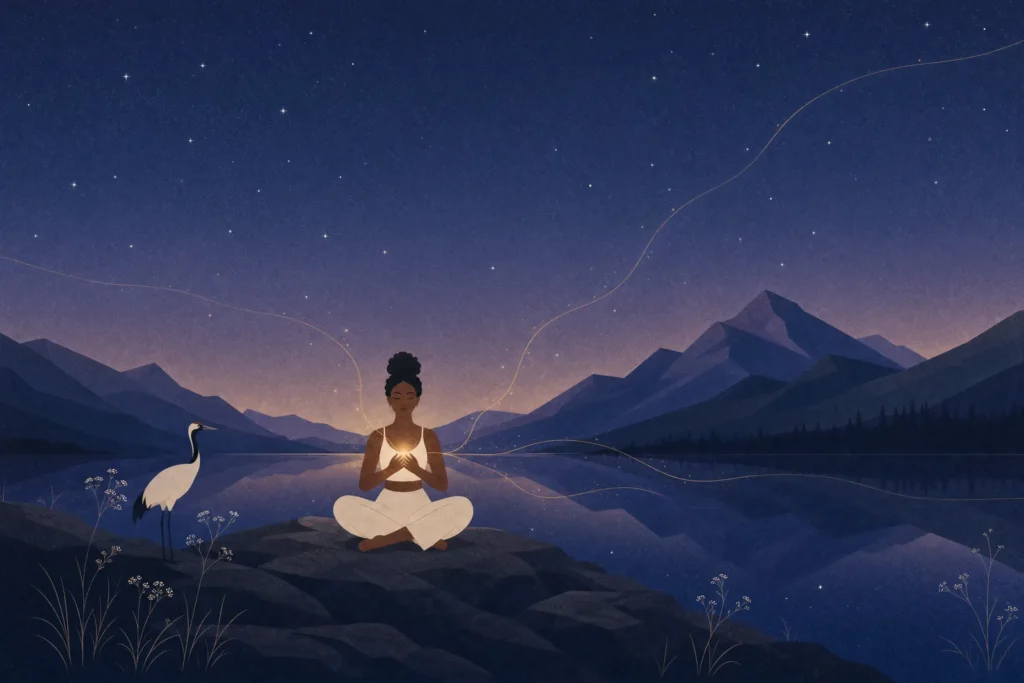
Spiritual awakening is the recognition that you are more than your physical body: that the self you experience is not produced by the body, and was never separate from everything around it.
For most people it arrives gradually: a slow loosening of assumptions, felt in the body before it’s understood by the mind. For some it arrives all at once, through an experience that leaves no room for argument.
Both are real. This article is about what is actually being recognised, and what changes afterwards.
Sudden awakenings are real
For some people, awakening begins with a single experience that changes everything at once. One of the most striking is an out-of-body experience.
An out-of-body experience is when your awareness leaves your physical body. You are still fully conscious, and you can still see and think, but you are no longer experiencing the world from inside your body. Instead, you are in your spiritual form.
These experiences often begin at the edge of sleep, after a strong buzzing or vibration moves through the body. The first time can be disorienting, even frightening, and it’s common to snap back into the body with a gasp. Once out, things can look slightly larger than normal, and movement follows thought: you think of where you want to go, and you go.
For someone who has never believed in anything beyond the physical, one experience like this can be enough. It is no longer a question of belief. It has been experienced.
A sudden awakening like that is not the norm. Most people’s recognition is slower and quieter. But it is worth saying plainly that it happens, because a great deal of writing on this subject treats sudden awakening as either fantasy or metaphor. It is neither.
The spiritual self is not a metaphor
A lot of writing in this space hedges, and we would rather not.
When we talk about the spiritual self, we do not mean a mood, a mindset, or a poetic way of describing calm. We mean something real: an aspect of you that is not produced by the body and is not dependent on it.

We are soul first, and body second.
That ordering matters, because it inverts the usual assumption. The common view is that we are physical beings who occasionally have spiritual feelings. Our position is the reverse: we are spiritual beings currently having a physical experience.
And this is not a separation. The spiritual self is not somewhere else, waiting for you after death or in some other realm. It is bound up with your physical experience right now: in your body, your attention, your sensations, the weight you carry in your shoulders. That is precisely why this work begins with the body rather than with ideas.
Why the word “spirituality” gets in the way
We as a society have clouded the term spirituality with too many different meanings. People are often put off by it, because it doesn’t align with their belief systems, or because it arrives wrapped in language that sounds like it belongs to someone else’s tradition.
In our work we use the term narrowly. Spirituality means aligning to the idea that we are more than our physical bodies, and that we have an energetic connection to everything that exists.
You don’t have to adopt a belief system to begin. Our aim has never been to change what anyone believes. It’s to point at something that can be experienced directly and checked against your own perception.
What is actually “awakening”?
In our understanding, everything is energetically connected. At that level we are already one, and nothing is truly separate.
But we come into this life with an ego self that experiences itself as separate from everything else. That sense of separateness feels self-evident. It is also, in our view, the ego’s central illusion.
Consider a fish in a fishbowl, unaware that it is swimming in water. Nothing about its situation is hidden. It simply has no vantage point from which to notice the medium it is suspended in.

We do the same with air, with our environment, with the whole web of conditions we exist inside. We may think or act as if we are separate from the rest of nature or the universe. In truth we are not. We are part of our environment, and even if we think of ourselves as a small and meaningless part of the whole, we are still within the whole.
So awakening is not acquiring something new. It is coming back into tune with a oneness that was always there, and that process starts within.
Becoming one with yourself
In the Ubunye Method, oneness begins at home. Before you can feel at one with everything, you have to become one with yourself.
Most of us aren’t, to begin with. We are divided in ways we rarely notice: between the thinking mind and the intuitive one, between the masculine and feminine parts of ourselves. Becoming one with self takes conscious work: a consciousness recalibration, in which those parts come into balance and blend. When they do, an intuitive connection opens.
That inner oneness is what brings you back into tune with the oneness everything already shares.
The ego and the higher self, explained plainly
Two terms come up constantly in this space, usually without definition. Here’s how we use them.
The ego is the operating self, the part of you assembled from your experiences, memories and conclusions about how things work. It’s not an enemy, and it isn’t something to destroy. It’s necessary. It is simply limited to what it has personally encountered.
The higher self is an extension of who you are, existing in a higher dimension of reality. It is your soul: the part of you that is not limited by your physical body. Its function is to guide, and it does so through your thoughts, arriving as sensory perception, feeling and intuition rather than as argument.
An analogy we use in our sessions: think of a computer.
- The hard drive stores information: everything you’ve gathered while being alive.
- The memory works in the background, like the subconscious, accessed differently from deliberate recall.
- The processor is the operating mind, taking data from both and producing thought.
Now imagine that computer has no internet connection. It functions perfectly well, but only ever with what it already holds. That’s the ego: capable, but confined to its own stored experience.
The higher self is the connection. And neutrality is the key to reaching it. When you are entirely neutral with what is, rather than pushing against it, you align toward it.
The way in is through the heart. In the Ubunye Method, the heart is the intuitive centre, the connection to the soul, and it’s through the heart that we connect with the higher self.
What does spiritual awakening actually feel like?
Sudden awakenings are the exception. For most people the process is quieter and more physical than they expect. What is shifting underneath is what the Method calls your state of being, and the sessions describe the work as adjusting “from a lower state of being to a higher state of being.”

A sense of weight coming off
Every time we let go of something that no longer serves us, the things limiting us become lighter. This is felt intuitively, as less weight on the shoulders, and it registers in the body before the mind explains it.
Less stress carried physically
Our attachment to stress causes the body to react, and everybody experiences that differently. The body can handle stress; what it cannot take is ongoing stress. Many people don’t realise how much they have been holding until it surfaces. This is especially true of strong-minded people, who often don’t notice they’re suffering until the body forces the issue.

Becoming the observer
A shift from needing to control outcomes toward being able to watch things unfold. The world turns on its own. We are here to take part in it, not to manage every result.
Belief systems loosening
As beliefs are re-examined, you are in a real sense reconfiguring your reality: what you once thought the world to be. The Method states the mechanism directly: “when we hold a belief system, we tune our reality towards it.” That can be disorienting before it is freeing.
And when awakening does arrive suddenly, it can be frightening at first. That fear is normal, and it passes.
Notice what isn’t on that list: certainty, or a finished state. Awakening is a direction, not a destination.
Is spiritual awakening religious?
No, and the Ubunye Method is not a religious practice.
Religions have been built around these questions (what happens when we pass, what existence means, why we are here), and they offer genuine guidance to many people. But awakening doesn’t depend on any of those frameworks. It’s a description of relationship, not a claim about doctrine.
Our work is spiritual rather than religious. It makes no claim about God or scripture that you are required to accept, and it asks you to adopt no belief system. You can come to it with no spiritual background at all. It is equally available to someone who holds a faith and to someone who holds none.
The name reflects this. Ubunye is simply the Nguni word for oneness, chosen for what it means, not as a cultural or religious affiliation. Oneness, in our sense, is both what we already are and what we work to become.
How it begins
Not with belief. With attention.

The work starts in the body rather than the mind, because the body is where the holding actually happens, and because the spiritual self is not somewhere else. It is available through your physical experience, not apart from it.
Try this now
- Sit comfortably and let your eyes close. Take three slow breaths without trying to change anything.
- Scan downward through your body and find where you are physically holding tension: jaw, shoulders, chest, stomach.
- Rest your attention there. Name the sensation rather than the story: “tightness”, not “work” or “my relationship”.
- Breathe into that place for ten slow breaths. Don’t push it to release. Just let it be observed.
- Notice, without judging it, whether anything eased.
- Then change its charge. In your inner voice, slowly, a few breaths each: “I am more than my emotions.” “I create flow through opening up to my tension.” This step is the one the Method adds, and it is where observation turns into change.
That’s the whole practice. If it brings up more than you expected, stop and open your eyes. That response is normal and worth reading about before continuing.
The full guided version of this work runs through Chapter 1 of the Ubunye Method, which builds body awareness before any of the deeper material begins.
Where this leads
For most people, spiritual awakening isn’t a single event you can point to afterwards. It’s a sequence of small recognitions, each one making the next a little easier, and each one leaving you carrying slightly less.
The Ubunye Method was conceived from a combined twenty years of experience in conscious spiritual development practices, and everything it teaches is, in a sense, spiritual awakening work. Not because it’s mystical, but because it keeps returning to the same recognition from different angles: that you are more than the physical, that you are soul before you are body, and that you were never separate to begin with. What settles as that recognition deepens is what the Method calls flow, which it ties to alignment rather than mood: “I flow when I am aligned; I am aligned when I flow.”
Learn more about the Ubunye Method
This article is for general education and is not medical or psychological advice. Meditation can bring up difficult emotions, and it isn’t suitable for everyone. Please read our disclaimer before beginning any practice.